Kids productivity apps
Kids Productivity App Cost in Australia (2026 Pricing Guide)
What a kids productivity and habit app costs in Australia in 2026. Real subscription prices, free vs paid, and how to compare family plans.
- Written by
- Mathew Walker
- Published
- Reading time
- 10 min read
- Category
- Kids productivity apps

Listen to this story
A calm audio version for your next quiet moment.
Habit app for kids aged 8–17 · Australia
Quick answer
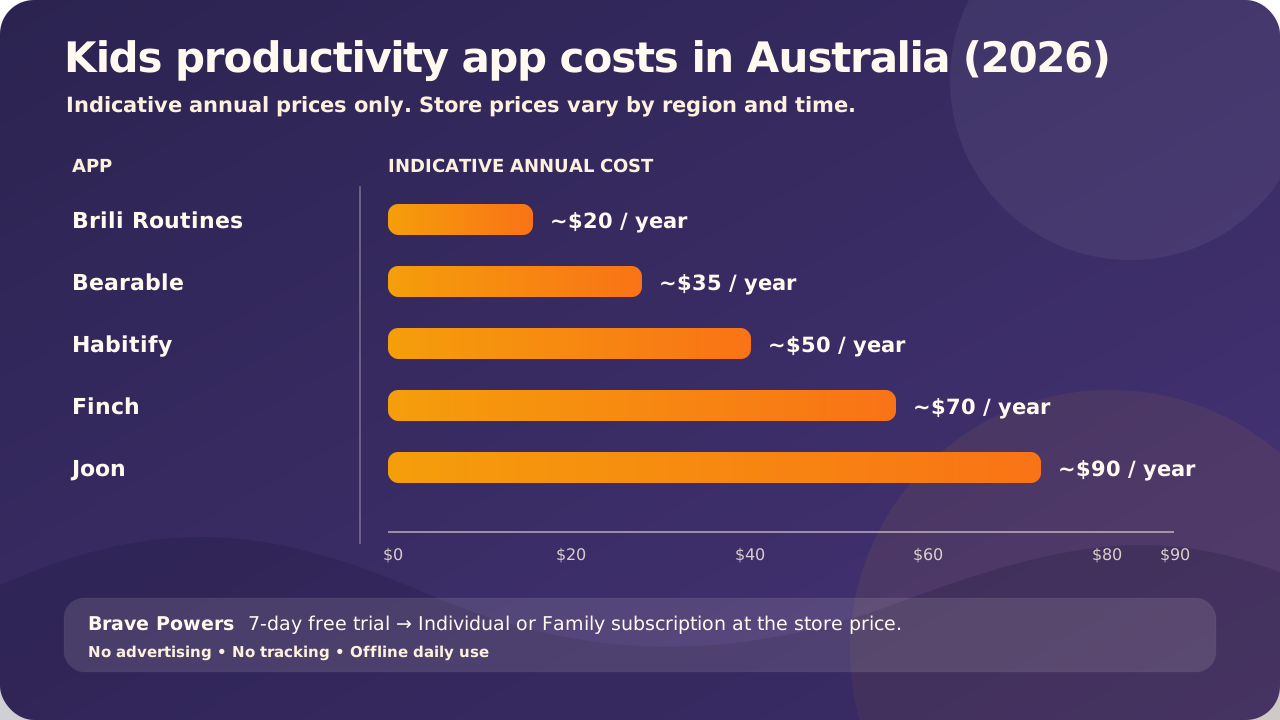
Kids productivity and habit apps in Australia are mostly subscriptions, and the indicative prices in current comparisons cluster between roughly $20 and $90 a year. A simple routine app usually sits at the lower end, while gamified habit trackers and family features push the price higher. Some free apps are funded through advertising, data collection or a limited free tier that gates useful features behind a paywall, so “free” is not always the same as low-cost.
Brave Powers gives families the whole adventure free for 7 days, then offers one subscription: Individual for one child profile on a device, or Family for up to six child profiles per device. There is no free tier, no advertising, no tracking and no child account. The app runs offline. The current price is shown by the App Store or Google Play before purchase.
How much does a kids productivity app cost in Australia? Most fall between $20 and $90 a year in the indicative comparisons below. Your actual cost comes down to how many children the plan covers, whether you pay monthly or yearly, and what the free version really includes. Compare the annual cost and the privacy model, not just the headline price.
What you can expect to pay
These are indicative published prices and comparisons. App Store and Google Play prices vary by region, tax, currency and promotions, and can change over time.
| App or basis | Typical cost |
|---|---|
| Brili Routines | Around $20 / year in published comparisons |
| Bearable | Around $35 / year |
| Habitify | Around $50 / year |
| Finch | Around $70 / year |
| Joon | Around $90 / year in the cited comparison |
| Streaks | Around $6 once |
| Brave Powers | 7-day free trial, then one subscription; current price on the store |
The pattern matters more than the exact number. Kids habit apps are cheaper at the lower end and climb when they add gamification, multiple children, synchronisation or premium features. A one-off app can look cheaper, but it may not provide the same family coverage or product model.
What actually drives your price in Australia
| Factor | Effect on price |
|---|---|
| Number of children | Family plans covering several children usually cost more than single-child plans, but can be cheaper than paying separately for each child |
| Subscription versus one-off | Most habit apps are subscriptions; one-off purchases are less common |
| Annual versus monthly | Annual billing is usually cheaper per month, but commits you for the year |
| Freemium versus premium | A free version may limit habits, profiles or useful features behind a paywall |
| Privacy model | Apps with no advertising and no tracking need a clear paid model rather than relying on attention or personal data |
| Offline versus cloud | Offline-only apps do not need servers for daily use, but they also do not provide automatic cloud synchronisation |
The last two rows are easy to miss. A low price can reflect a different business model, and a cloud feature can change both the product and the privacy questions a parent needs to ask.
Why the cheapest app usually costs more
Be cautious of a “free” kids app. Some free apps are funded by advertising or data collection. Others give you a free tier that is so limited that the useful parts sit behind a paywall. You may not pay money at first, but you can still pay in attention, privacy and time if the routine disappears when the novelty wears off.
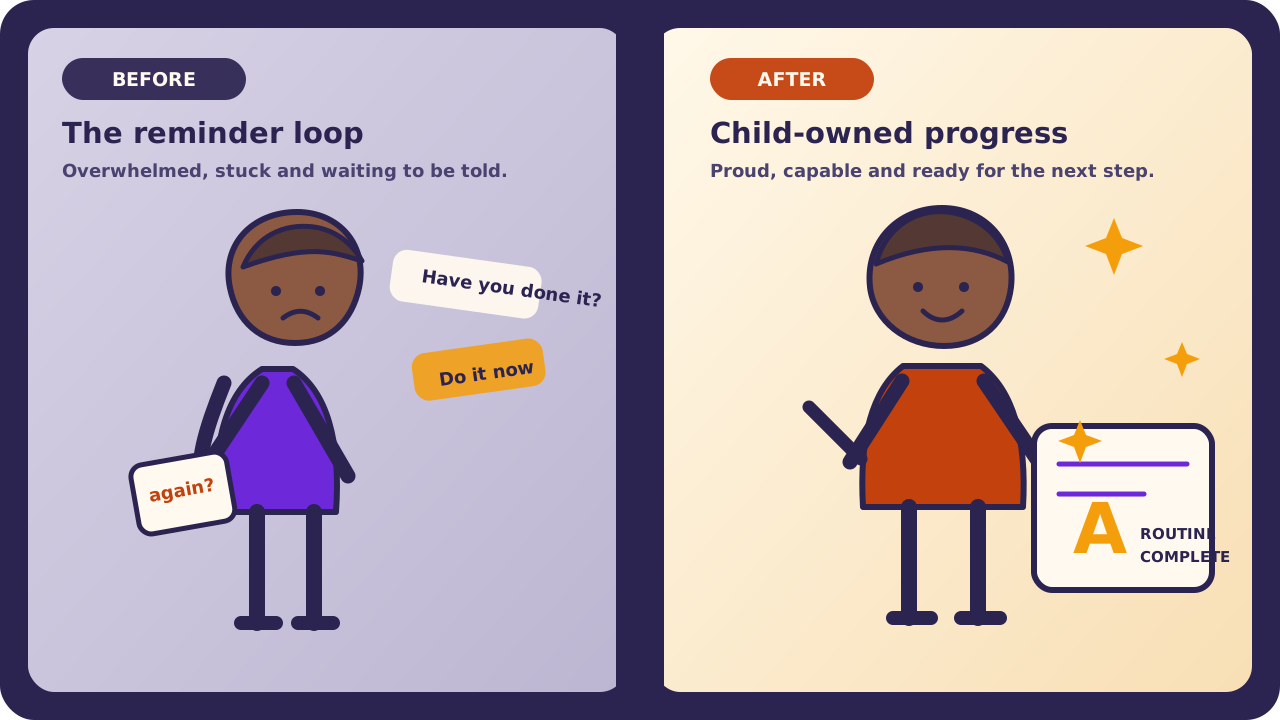
A fair price is one subscription that covers what your family actually needs: the right number of children, no advertising, no tracking and a routine the child can run themselves. If an app cannot explain plainly how it makes money, that is part of the buying decision.
Frequently asked questions
What is the average cost of a kids productivity app in Australia?
The indicative range in current comparisons is roughly $20 to $90 a year. Simple routine apps sit lower, while gamified trackers and plans covering several children can cost more. Brave Powers offers a 7-day free trial, followed by one Individual or Family subscription shown through the relevant app store.
Can you compare prices for kids habit apps in Australia?
Yes. Put each app beside the same three questions: how many children the price covers, whether billing is monthly or yearly, and what the free version actually includes. A cheaper app that covers one child or gates its useful features may not be cheaper for your family.
Why are kids productivity apps priced by subscription rather than a one-off purchase?
A subscription supports ongoing updates, support and continued access to the product. One-off purchases still exist, but many current habit and productivity apps use monthly or annual pricing. Compare the yearly cost and the features you will use rather than assuming one billing model is always better.
Is a free kids habit app actually free?
Sometimes, but check what funds it and what the free tier includes. A free app may use advertising, data collection or a restricted feature set. “Free” is only a useful comparison when you also understand the privacy model and whether your child can use the routine without reaching a paywall.
How much does a kids productivity app cost per month in Australia?
The indicative range of $20 to $90 a year works out at roughly $2 to $8 a month when averaged across twelve months. Monthly billing can cost more over a year than annual billing. Brave Powers shows the current store price before purchase, and the store manages billing, renewal and cancellation.
What affects the cost of a kids productivity app?
The number of children it covers, whether it is a subscription or a one-off, monthly versus annual billing, and what the free tier includes. The privacy model matters too. An app with no advertising and no tracking has a different cost structure from one funded by attention or personal data.
Do apps for more children cost more?
Usually, but it depends on the plan. Single-child plans are often cheapest. Family plans covering several children can cost more than an Individual plan, but they may be cheaper than paying separately for each child. Brave Powers Family covers up to six child profiles per device.
How much does it cost to add a second child to a plan?
There is no universal answer. Some apps charge by profile, while others include several children in a family plan. Check the plan limit before buying a single-child subscription for each child. Brave Powers Family is designed for up to six child profiles per device.
What should a kids productivity app subscription include?
Start with five practical checks: enough child profiles for your family, no advertising, no tracking, protected parent settings and a routine the child can run themselves. The point of paying is that the app supports the child’s ownership rather than creating another task for the parent.
What Families Are Saying
Brave Powers is newly launched, so there are no published customer reviews to quote yet. We will add verified App Store and Google Play feedback here when real families choose to share it. No testimonials are invented for this guide.
Start your 7-day free trial
Try the whole Brave Powers adventure free for 7 days through the App Store or Google Play. After the trial, choose Individual or Family if the app is helping your family.
How to compare three apps side by side
Three kids habit apps can describe three very different products: one may be a routine timer, one may be a gamified world, and one may rely on advertising or data collection. The gap is rarely just the price. It is what the app is actually for and how it treats your family’s information.
Make every app answer the same five questions before you look at the price:
- How many children does the price cover? A one-child plan is different from a family plan. If you have two or three children, per-child pricing can multiply quietly.
- Does it show advertising or track my child? A kids app with advertising or third-party tracking is not free in the privacy sense. Check the privacy policy and the app-store disclosures.
- What does the free version actually include? If you reach the paywall after a week, treat the free tier as a trial rather than a permanent option.
- Is billing monthly or annual, and what happens when the trial ends? Annual billing can be cheaper, but make sure you understand renewal and cancellation before starting.
- Can the child run it themselves? The purpose is independence. If the app still requires a parent to drive every step each night, it may have moved the reminder loop onto a screen.
Once all three apps answer those questions, the comparison usually becomes clearer. The cheapest app is not automatically the best-value app if it costs more in attention, privacy or parental effort.
Is a kids productivity app worth the money for an Australian family?
We would rather answer this honestly than sell you a subscription you do not need. If a paper chart on the fridge works in your house, keep using it.
There is useful evidence behind the importance of repetition. Lally and colleagues’ 2009 study found that the time needed for a behaviour to become automatic varied widely, from 18 to 254 days, with a median of 66 days. Missing one day did not erase the process, while consistent repetition over time mattered. Scientific American’s summary of the research and the original study reference explain the limits of the popular “21 days” claim.
That is the practical job a good habit app can do. It can keep a routine visible through the boring middle, celebrate small wins and turn a missed day into a new morning instead of a failure. It cannot guarantee better grades, behaviour or wellbeing. The work still belongs to the child and family.
Australian families also have to make deliberate choices about device time. The Australian Bureau of Statistics’ 2023 National Nutrition and Physical Activity Survey reported that 28% of children aged 5–17 met the sedentary screen-time recommendation, while 60% used screen-based devices in the hour before bed. The question is not whether a device is automatically good or bad. It is whether the time and product support the family’s goals.
Then there is the hidden cost many parents recognise: the nightly reminder loop. The prompt, the pushback, the guilt and the chart that eventually comes down. You cannot put a precise number on it, but a routine app is only worth paying for if it helps the child take more ownership rather than giving the parent another system to manage.
If a genuine trial shows that the app is not sticking with your child, stop it. Brave Powers’ terms explain that earned progress remains preserved if a subscription ends, and store billing, renewal and cancellation are managed by Apple or Google.
Read how Brave Powers works or choose a plan.
Related reading
- Brave Powers — the habit app where kids grow their own world
- Find your plan
- How Brave Powers works
- Terms of Use
Start your 7-day free trial
Try the whole adventure free for 7 days through the App Store or Google Play. No advertising, no tracking and no child account. Just Brave Powers and five small daily steps.
This article is general information about kids productivity app pricing in Australia. Prices are indicative, vary by region and change over time. It is not advice to buy any particular app. Check the App Store or Google Play for current pricing, trial and renewal details.
Sources
- Common Sense Media: Brili Routines
- HabitBox: habit tracker app comparison
- KudoKids: kids app alternatives and comparison
- Jotform: habit tracking apps
- Scientific American: how long habits take to form
- Lally et al. (2009), European Journal of Social Psychology
- Australian Bureau of Statistics: children’s physical activity, screen time and sleep
- Brave Powers Terms of Use